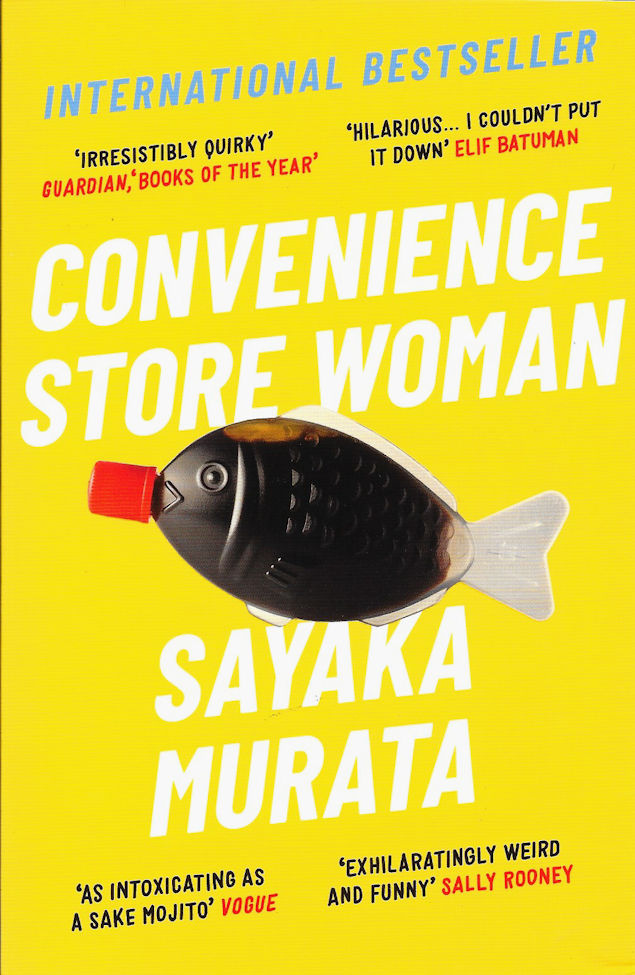
Review: Convenience Store Woman
Convenience Store Woman is a subtly strange and thought-provoking novel, although not nearly as unsettling and creepy as Earthlings. Its plot is relatively simple on the surface, but beneath that simplicity lies an exploration of identity, conformity, and the cost of societal expectations.
The story follows Keiko, a woman who has devoted her life to working at a convenience store. Through her perspective, an ‘outsider’ by societal standards, you’re confronted with the harsh reality of how unforgiving society can be toward those who don’t fit the norm.
Keiko finds genuine purpose and fulfilment in her job, but this devotion is neither understood nor respected by those around her. There’s a quiet tragedy in the way her future is foreshadowed: eventually, she won’t be able to work due to age or health, and when that happens, she’ll be cast aside without a second thought. There is no security for her. And you know, through how she talks about life and the store, she will not be able to live without it. To her, it’s her life.
One particularly frustrating aspect of the story is how people around her are only satisfied when she gets into her first relationship at 36. Ironically, this man is immature, manipulative, and clearly exploiting her, yet others overlook that simply because she’s no longer single. His behaviour is absurd, at times even infuriating, yet society sees the relationship as progress.
Ultimately, Convenience Store Woman asks us to question the paths we’re expected to follow: Why is success measured by a “meaningful” or high-paying job? Why are marriage and children seen as essential milestones even when you don’t want to? If we only have one life, shouldn’t we live it in a way that truly makes us happy, even if that means being different?
The following quotes/passages contain some minor spoilers.
People have a duty to fulfill their role in society either through the workplace or the family.
When you work in a convenience store, people often look down on you for working there.
There were two type of prejudiced people – those who had a deeprooted urge for prejudice and those who unthinkingly repeated a barrage of slurs they’d heard somewhere.
The normal world has no room for exceptations and always quietly eliminates foreign objects. Anyone who is lacking is disposed of.
However hard I work, however dependable I am, when my body grows old then no doubt I too will be a wornout part, ready to be replaced, no longer of any use to the convenience store.
He seemed to have this odd circuitry in his mind that allowed him to see himself only as a victim and never the prepetrator.
Yet here he was attacking me with the same kinds of reproaches that were making hims uffer. His argument was falling apart I thought.
She’s far happier thinking her sister is normal, even if she has a lot of problems, than she is having an abnormal sister for whom everything is fine. For her, normality – however messy – is far more comprehensible.