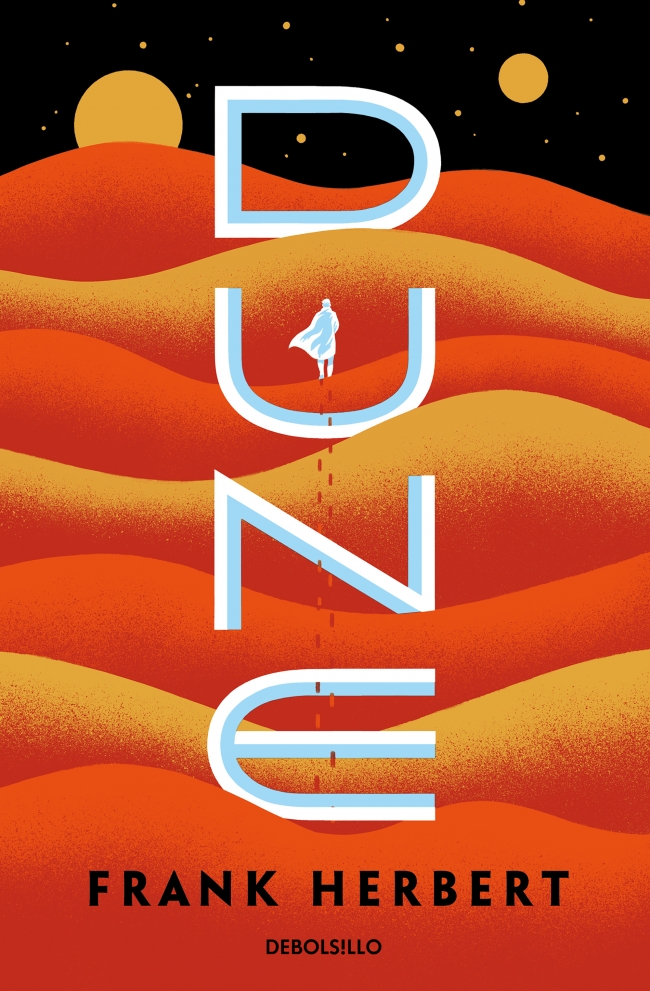
Review (spoilers): Dune
I think reading Dune reminded me why I need to finally tackle all those books I’ve been putting off—because every time I do, they turn out to be incredible!
The omniscient POV wasn’t my favourite at first since it made it harder to deeply connect with the characters or feel truly invested in them. However, for a story of this scale, focused on the bigger picture rather than individual arcs, it ultimately felt like the right choice. Still, there were moments where certain events felt underdeveloped; some significant actions happened in just a single sentence, which made things feel a little abrupt. The writing itself was a mix for me: sometimes weak and clunky, other times great and quotable. It often felt like the themes were prioritised above everything else.
The characters were interesting, each with their own motives and agendas, which I loved. That said, some could have used a little more personality or depth. For instance, Chani is portrayed as Paul’s great love, and he goes to incredible lengths for her—even as he grows increasingly detached from individuals in general. But why? I would have loved more insight into things like this.
On the other hand, the Bene Gesserit were absolutely fascinating, and I can’t wait to see more of them in the following books.
What I loved most was the complexity of the worldbuilding—the layers of interplanetary politics, culture, and ecology were incredible. I generally enjoy books that require full attention because of their depth, and Dune falls perfectly into that category. The focus on ecology was especially compelling and opened the door to thought-provoking ideas and conversations. I found the Fremen’s long-term vision of creating a livable planet, knowing it wouldn’t happen within their own lifetimes, profoundly moving. Beyond that, the themes of religion, power, colonialism, and humanity were interwoven beautifully into the narrative.
Despite its little flaws, Dune is a remarkable and ambitious work that stays with you long after you finish it.
I both love and hate you.
Once men turned their thinking over to machines in the hope that this would set them free. But that only permitted other men with machines to enslave them.
She said a ruler must learn to persuade and not to compel. She said he must lay the best coffee hearth to attract the finest men. …. The she said a good ruler has to learn his world’s language, that it’s different for every world. … She said she meant the language of the rocks and growing things, the language you don’t hear just with your ears.
She had loved pansies… or was it daisies? He couldn’t remember. It bothered him that he couldn’t remember.
If I made him do … this, then it would not be his doing.
The people must learn how well I govern them. How would they know if we didn’t tell them?
Power and fear. The tools of statecraft.
The gift is the blessing of the giver.
He said the drowning man who climbs on your shoulders to save himself is understandable – except when you see it happen in the drawing room. And, I should add, except when you see it at the dinner table.
But it’s a human trait that when we encounter personal problems, those things most deeply personal are the most difficult to bring out for our logic to scan. We tend to flounder around, blaming everything but the actual, deep-seated thing that’s really chewing on us.
The people respect our dead. Custom differ, but the meaning’s the same.
Fear is the mind-killer. Fear is the little-death that brings total obliteration. I will face my fear. I will permit it to pass over me and through me. And when it has gone past me I will turn to see fear’s path. Where the fear has gone there will be nothing. Only I will remain.
What senses do we lack that we cannot see or hear another world all around us?
“spannungsbogen” – which is the self-imposed delay between desire for a thing and the act of reaching out to grasp that thing.
The people who can destroy a thing, they control it.
Deep in the human unconscious is a pervasive need for a logical universe that makes sense. But the real universe is always one step beyond logic.
How often it is that the angry man rages denial of what his inner self is telling him.
One of the most terrible moments in a boy’s life, is when he discovers his father and mother are human beings who share a love that he can never quite taste. It’s a loss, an awakening to the fact that the world is there and here and we are in it alone. The moment carries its own thruth; you can’t evade it.
It’s as easy to be overwhelmed by giving as by taking.